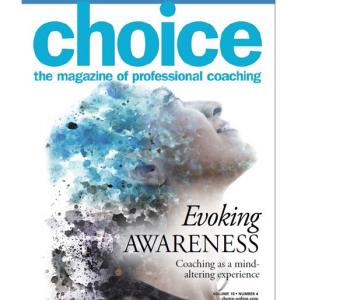
Clients Inner Movie as Seen in CHOICE Magazine
As Seen in CHOICE MagazineCoach Training | David Giwerc
CHOICE Magazine's featured article: A Client’s Inner Movie, shares important insight, knowledge, and research to encourage clients to build their “inner witness” so they can objectively observe what is going on in their lives.
______________
Think of your life as a movie. What if you could watch your life movie as if you were a spectator in the audience? There you are, munching on popcorn and sipping soda. On the screen is the story of your life, whatever that story might be in the moment. In the movie, emotions may get heated; the scene may be one of anger, frustration, or sadness. It may seem to be headed toward a difficult or tragic ending. But out in the audience, you watch yourself onscreen with detachment. You suspend all disbelief and focus on possibilities. You are like a fly on the wall watching your movie from a distance, removed from any attachment to a final outcome.
In life, your reactions may be impulsive, driven by a dominant, negative pattern, or you may be paralyzed by in- decision or inaction. Yet out in the audience, watching your movie, you are detached from the intensity of the moment. You watch yourself without judging, as an outsider. And suddenly, it becomes so easy to detect destructive patterns in your behavior.
In the movie, it’s so clear how you limited yourself and reacted according to old beliefs about yourself that weren’t serving you well. But out in the audience, you don’t blame the character onscreen – rather, you watch and learn.
THE PAUSE CREATES SELF-AWARENESS
This is the essence of self-awareness: being able to emotionally distance yourself by learning to pause and pay attention to what you are paying attention to and witness what your movie is revealing. Pausing and witnessing are the foundation for creating new self-awareness.
In more than 20 years of coaching, almost entirely with clients with ADHD, I have noticed that most of them have not learned to pause and pay attention. Without the pause, there is no awareness or understanding of the cause. There is no ability to notice what is getting in their way so they can get it out of their way.
When clients learn to pause and pay attention in a non- judgmental, non-attached, objective, and open way, their inner witness will become available to objectively watch what is going on in their life. The information they gather can then be used to make choices that are neither impulsive nor reactionary but aligned with what they truly want in life.
COACHING CREATES A NATURAL PAUSE
Coaching is a platform that encourages a natural pause through questioning. An evocative question can activate the brain to stop and notice what is going on by stimulating interest and cueing the client to pause and respond rather than react. Asking a simple but powerful open-ended question, such as, “How do you know when to pause?” often leaves clients dumbfounded.
They also have no idea that every thought they focus on creates electrical signals in the brain which eventually are converted into bodily sensations. These bodily signals called feelings are associated with an emotion. Having the ability to name the emotion as it is occurring is the foundation to the essential life skill of emotional intelligence. Without emotional intelligence, there is no ability to effectively manage our emotions.
Unfortunately, research tells us that only about a third of the world’s human beings possess the ability to identify an emotion (emotional intelligence) as we are feeling it in the moment.[1]
THE FLY ON THE WALL
By mirroring their thoughts and asking evocative questions, coaches can create an automatic pause so the client can engage in the process of becoming aware of the emotion they are focusing on in their life movie and reflect on its impact. Coaches can also empower clients to watch their movie from a self-distanced perspective [2] as they reflect on their feelings and view themselves in their experience; for example, from the perspective of a “fly on the wall.” Research has revealed that when individuals reflect on their own negative experiences (negativity is the brain’s automatic default focus [3] a self-distanced perspective, (using their name vs. I), they feel significantly less distressed.
So, after actively listening to client Jim, who is having automatic negative thoughts about his inability to get a proposal in on time, I might say, “I hear Jim say that he will never be able to complete his work proposal in time. Where’s the evidence that what Jim is saying will never happen?”
Other questions I might ask:
- What does Jim think happens to his ability to get the work done when he says it “will never happen?
- What words could Jim use to support his ability to complete his proposal on time?
- What experiences or events has Jim forgotten that are reminders of who he is and his capabilities?
- What does Jim notice when he revisits successful, fulfilling moments in his life?
- How would Jim describe what happens to him when he remembers to revisit those experiences?
- Who does Jim become?
Notice I use the client’s name rather than the first-person pronoun “you.”
The Client’s Inner Witness
Coaching this way allows clients to watch and notice what they are observing in the third person, as though they were a fly on the wall watching it all. Practicing it in coaching sessions anchors the skill so they can do it alone.
When an experience occurs that activates uncomfortable bodily sensations, it becomes their cue to pause and pay attention to what they are paying attention to in the moment and say to themselves, “Hmm, that’s interesting. There is Jim acting out that same movie he watches all the time. Jim needs to change the plot so he can move forward. What is the new movie Jim can produce that will serve him well?”
It may at first feel strange. But your client’s inner witness is a powerful ally that can help him change his life movie.
DISCOVERING THE OBJECTIVE SPECTATOR
The coach encourages clients to naturally slip into the role of objective spectator, rationally observing and not emotionally immersed. That way, they can notice their movie and not get caught up in the drama which otherwise may have emotionally affected and/or immobilized them.
If the plot of the client’s movie is a strongly held belief that needs to be challenged, he can learn to recruit his inner witness to challenge that troublesome belief. The client, through coaching, can discover that his inner witness is equipped with an acute awareness of what his conscience needs in order to be at peace in the present moment.
THE CLIENT’S CONSCIOUS CONSCIENCE
This awareness is the unique consciousness that your client’s inner witness possesses. I call it their “conscious conscience,” that part of them that intuitively knows what is in harmony with their values and vision. Their conscious conscience also knows that the only thing they can control is what they choose to think about right now.
For the client’s witness to be conscious of their conscience, they must have the ability to be present in the present with their presence.[4] This means being present (with all of their senses) in the present (right now) with their presence (the core essence of who they are). Then they can engage with the scene unfolding before them, giving it their full attention.
By pausing to watch the “movie” of their life, they are committing to engage in the present. They are not replaying the past or worrying about the future. They are living the moment right now. They can see their life from all angles at once. They can see their presence as whole and complete.
Published in, and reproduced with permission from, choice, the magazine of professional coaching www.choice-online.com
"If you are interested in reading more CHOICE articles, use ADDCA's special coupon code, AUTHOR25, to receive a 25% discount off a print, digital or combo subscription: Subscribe Here
__________________
NOTES
1 Bradberry, Travis, Greaves, Jean, (2009). Emotional Intelligence 2.0, San Diego, CA. Talent Smart.
2 Kross, E., Bruehlman-Senecal, E., Park, J., Burson, A., Dougherty, A., Shablack, H.,…Ayduk, O. (2014). Self-talk as a regulatory mech- anism: How you do it matters. Journal of Personality and Social Psychology, 106(2), 304–324.
3 Baumeister R., Bratslavsky, E., Finkenauer, C., Vohs, K., Bad Is Stronger Than Good, Educational Publishing Foundation, 2001
4 Giwerc, D. (2011). Permission to proceed: Creating a life of pas- sion, purpose, and possibility for adults with ADHD. Springfield, UT: Vervante.